Wednesday, April 11, 2012

On A Mission
By Michael

This guy (or gal?) perked up to greet his long-lost buddies.
Shortly before we left La Paz, we fulfilled a final obligation: we repatriated some hermit crabs the Wondertime crew took from the beach at Bahia Gato a few months ago. Bahia Gato is about 90 nautical miles north of La Paz, up into the Sea of Cortez. It was a good shakedown of the boat changes and fixes we completed during our three-month La Paz stay.

It was only a six-day trip, just there and back really, but we had a great time and the voyage was made even more special for two reasons.

First, the girls spent more than 5% of the time on deck. Usually, they hunker down below, likely suffering a bit of mal de mer. But this time, they were topsides with us at least half the time, and enjoying themselves.

The other reason this trip was memorable: blue whale sightings! They really are blue, a pale shimmering silver blue, unmistakable from the humpback whales and sperm whales we've seen. And they are unmistakably larger than other whales we've seen. For each of the 10 sightings, we saw only the back of the whale, no breaching or fancy fluke raising before a dive. But these backs are so broad and large it is startling. Smooth and glistening in sunlight. Blue whales are not just the largest animals on the planet, they are the largest animals known to ever exist. Like all the other whales, we never saw them before first hearing them, a loud whoosh from their blow hole. No, we don't have any pictures of them...but following are the other pics from our mission.

--MR

Captive life was not as grand. Note the collection of hermit crabs just visible
in the crevice where the sand meets the rock.


Windy and the girls helping guide the long-journeying crabs back to their cousins.
Eleanor (left) and Frances (right) scrambling on the smooth red sandstone
at Bahia Gato.
We hiked up to get a better view of our boat at anchor here at
Isla San Francisco, a waypoint on our trip to Bahia Gato.

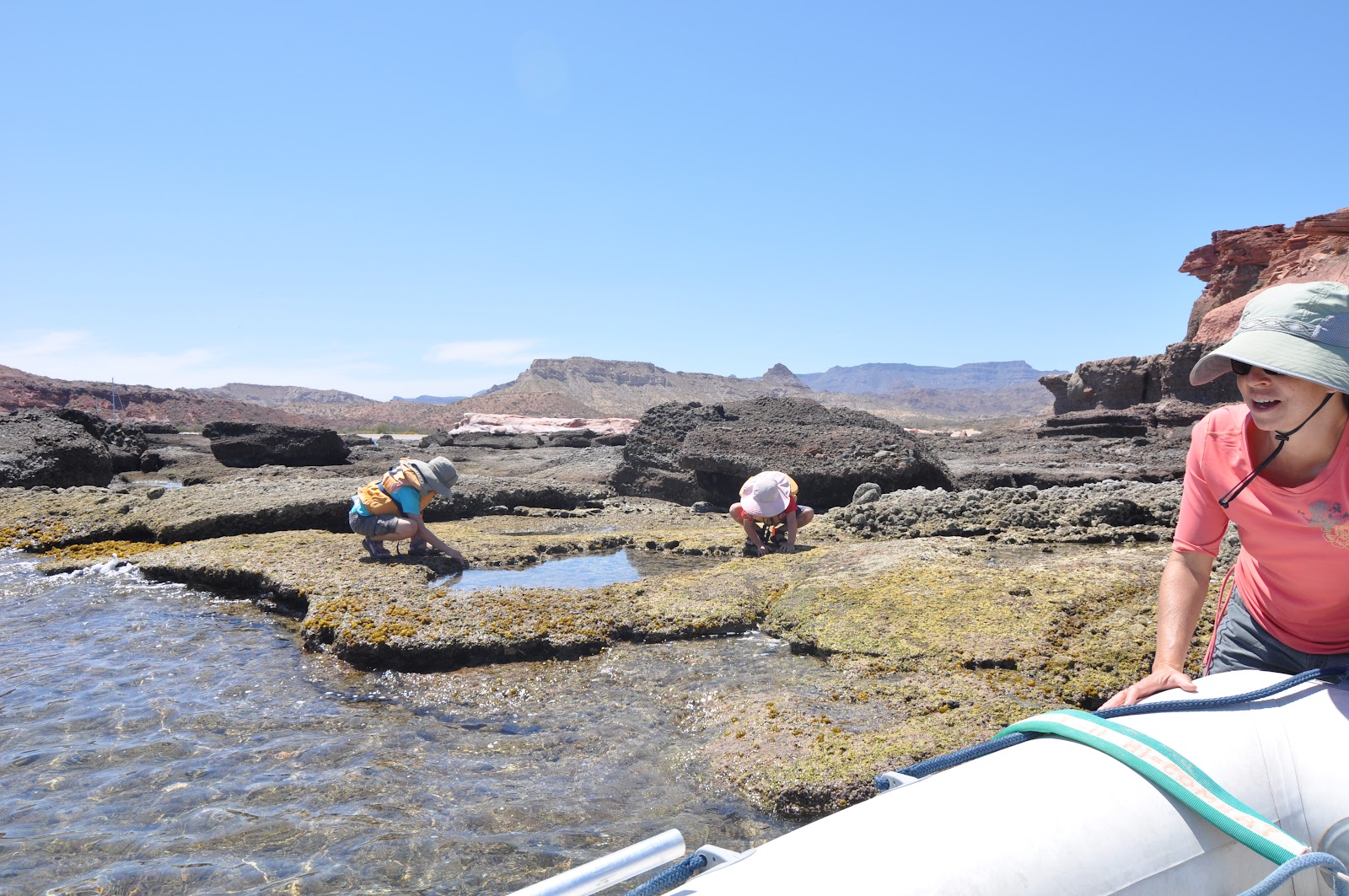
Windy holding the dinghy off sharp rocks while the girls mess about in the tidepools.
The shoreline of Baja is interesting, everywhere. See the little speck on far right, center?
That is Frances's hat and shoulders, busy moving sea snails around in the tidepools. That's
our dinghy up on the beach beyond her.
Frances watches Eleanor zip by at 15 knots, me towing her on
the boogie board behind the dinghy.

Monday, April 9, 2012

Vagabundos Del Mar
By Michael

The strawberries we've bought from the back of this Ford Escort
over the past three months have been the best, most consistently
good strawberries I've bought anywhere. We must have
purchased four dozen baskets (canastas) since we arrived.
At 5 for 50 pesos, that's only 80 cents U.S. a basket.
It’s curious, feeling ready to leave a place you like. We arrived in La Paz at the start of this year, the first week of January. We now know the city. We own the streets and the faces we see are familiar. We have our favorite restaurants. I push my cart around the grocery store in a pattern and I don’t need to ask where anything is. We’ve filled our propane tanks a few times and we’ve done dozens of loads of laundry. We live here. We like it here. We’re feeling ready to leave.

There is no reason we couldn’t stay in La Paz, dig deeper roots. There is no reason we must leave. We just want to go someplace else, see something else. I guess this is wanderlust.

There is nothing like it in a land-based life. Nobody gives thought to moving for the sake of moving. How would you get to work on time if you lived a hundred miles away next week? What an expensive and inconvenient proposition to pack and unpack all of your stuff, to move into a new place.

But imagine if the situation wasn’t so. Imagine if it was only a matter of deciding to leave. What if it took ten minutes to detach your home from its foundation and float away, coming to rest whenever you wanted in someplace entirely new? No packing, no hassle, just making sure you have groceries and water, and going…from Los Angeles to San Francisco, from Washington, D.C. to New York, from Houston to Lake Tahoe, from Portland to Aspen. When you arrived, you would walk out your front door to someplace new. You may be in a different climate. You would have to learn where everything is, maybe even a new language. You could stay as long as you wanted; you could always return to where you were. Could you? Would you?
Aramburo (aka the cow store) is "our" supermarket in La Paz.

This is cruising.

We want to leave La Paz and head for British Columbia. We hear it is beautiful—no, magnificent. We want to anchor near waterfalls, see orcas, and soak in natural hot springs when the air is cold enough to condense our breath. We will miss cactus, palm trees, warm water, and the friends we've made here. We’d like to see glaciers and rugged vistas that test the infinity setting on our camera. We are leaving tomorrow.

We have lots of friends and family with whom we want to visit on the west coast of California, Oregon, and Washington, so it will take us a long time to get up to British Columbia, probably a few months. We may winter over in Victoria and then get a jump on the summer cruising season next year, high-tailing it up to Alaska or something. Or we may not.

From the time we arrived in Mexico to begin our adventure, we have been bound by the projects we wanted to complete on Del Viento. There remains a short to-do list we’ve saved for San Diego, but we are otherwise untethered. We leave tomorrow, all of us eager to see where we go in the next few months—in the next few years—and how long we stay there.

--MR

The girls scrambling over the deck with their little baskets Easter morning
to find the hidden chocolate eggs.


And this is where they ended up Easter night, at a bar, playing Barbies
with others while their parents hung out with other parents, drinking
beer and listening to live music. That's Frances on the left, Emma of
Whiskey Charlie in the middle, and Raquel, the bar owner's
daughter on the right. Of course, in Mexico this is perfectly fine.
In fact, when the waitstaff was busy, I sent Eleanor to the bar
to order and bring back a pitcher of Negro Modelo--try that
at home.


And this is how many Mexican families spend Easter (usually the whole week,
called Semana Santa): picnicking on the beach.
Our friends Rick and Kyra of Nyon are proof that we don't
just hang out with other cruising parents. They inspired us the other
night aboard Nyon to consider wintering over in their hometown,
Victoria, Canada. Kyra's an artist, check out her work here

Friday, April 6, 2012

What's The Frequency, Kenneth?
By Michael

Here I am using our handy new deck/anchor wash
system to spray the krill off me after cleaning
the hull and prop.
I posted last week about the Puddle Jumpers, a nickname for those cruisers currently making their way across the Pacific Ocean from the Americas. Most of them check in daily on one of a few nets set up for folks voyaging under sail in this region. For these nets (and hundreds like them), folks transmit over high frequency radio bands.

Our friends aboard Convivia and Wondertime check in nightly (0200 Greenwich Mean Time aka Zulu Time aka UTC) on the Pacific Puddle Jump Net at the single sideband (SSB) frequencies of 8294/8297 KHz. This means that anyone within thousands of miles of them
with a shortwave radio can tune in and perhaps listen to the transmissions and even talk to vessels underway.

Many cruising boats (including ours) have these radios and use them for long-distance communications with other boats and shore-based stations, for obtaining weather and news, and for sending short emails using special modems and software. These radios are large, appear complicated (to me), use a huge antennae (most sailboats run one up the mast or use their standing rigging as an antennae), and require a lot of power to transmit.

But it is pretty cool to listen to these transmissions (or to the BBC, for example). The sound quality is sometimes surprisingly good, but usually hissy and crackly with high-pitched squeals in the background—like tuning a 1920s tube radio to hear one of President Roosevelt’s fireside chats. In our modern age where I can walk down the street of any big city with my iPhone and enjoy a crystal clear conversation with someone on the other side of the planet, shortwave radio communication is quaint—and fundamentally unchanged since World War II. But these radios (including both the HAM and SSB bands) remain  a dominant means for communications on the high seas (though it is probably only a matter of time and price declines before satellite internet access usurps them).
I recorded Sara of Wondertime checking in the other night on her way across the Pacific. If this 90-second recording from a little boat about 1,000 miles out to sea doesn’t excite you, you may not be cut out for cruising. Enjoy (following this is a transcription).


Sara: This is Wondertime, how do you copy us, over.

Net Controller: You are right next door, literally. Go ahead.

Sara: Roger that, I figure we’d come in okay. Okay, it’s, uh, oh two hundred Zulu, Wondertime, whiskey-delta-foxtrot-five-eight-four-eight. We’re at zero six degrees, three three minutes north, one two four degrees, two two minutes west. We’re steering two two two true. Our speed is four decimal five knots. We have, uh, northeast one five knots of wind. Uh, we have a northeast three meter swell, six zero percent cloud cover and our bar is at one zero zero seven and that’s steady. How copy, over.
The Icom M710 is aboard Del Viento.

Net Controller: Oh, you were so loud and clear. Okay, I’ll read back to you. At zero two hundred zulu, Wondertime was at zero six degrees, three three minutes north, uh, one two four degrees , two two minutes west. Uh, two two two degrees true, speed four point five knots. We’ve got northeast wind at fifteen knots, northeast swell three meters, the cloud cover, uh, sixty percent, and barometer one zero zero seven millibars, sounds familiar. How did you get that, any corrections?

Sara: Nope, you got it. Uh, all is well on board and, uh, we have no traffic.

Net Controller: Okay, roger that. Well blaze away, we’re right behind you. I’ll break with you and go to Convivia…

--MR


Windy (reflected) is in charge of the radio aboard Del Viento. She obtained
her HAM radio license before leaving so we could transmit on
those bands if we wanted (though no HAM license is required for SSB).

Tuesday, April 3, 2012

Fiberglass For Everyone
By Michael

This is Eleanor this morning, assuming her first
formal watch under power as we headed back to La Paz.
She kept an eye on the temperature gauge, followed our
course on the iPad, changed course using the autopilot,
watched for other traffic, and advised of any wind
changes that may allow us to sail. She did all of
this for about 90 minutes. She was proud.
Before the 1950s, boats were made of wood, by craftsmen. They cost a lot of money. If you didn’t live like the Kennedys (or weren’t hired as crew by the Kennedys), you probably didn’t spend time ocean sailing.

Then fiberglass came along. It was relatively cheap, fast, and easy to build with. Recreational sailing was suddenly accessible to a burgeoning, post-war middle class. Fiberglass changed everything.

But the unanticipated longevity of fiberglass (the material isn’t prone to rot like wood) means that most boats built over the past 50 years are still with us. That is a lot of boats (and every year they build more). Fiberglass durability is changing everything, again.

Our boat is 34-years-old, built in 1978. Most of the boats of the cruisers we’ve run into were built in the 1980s--some a bit older, some a bit newer. As the fleet of fiberglass boats grows and ages, prices of older boats drop. We paid $64,000 for Del Viento and put half again as much into her. But the replacement cost indicated on our survey is $499,500. The family of four who crew Knee Deep, a 1984 Catalina 38, famously paid $25,000 for her (the base price of a 2012 Catalina 38 is over $280,000)--a boat Lin and Larry Pardey said would be their first choice if they were to buy a fiberglass cruising boat. In our 20s, Windy and I cruised from California to Florida over 7 months on a 1980 Newport 27 for which I paid $8,500 (in 1993).

I’ve written before that there is a path to the cruising life for just about anyone who wants it (and few do). The cost of entry is not a limiting factor. If you have any doubts, watch the movie below. It stars the crew of a boat named Pestilence. The title of the movie is Hold Fast and it is the brainchild of a sharp, eccentric, 20-something guy named Moxie Marlinspike. In short, the documentary is about buying a $1,000 boat and cruising on a shoestring budget, taken to a far-out extreme by Moxie and three friends (who needs a dinghy motor when you have a friend with fins?). Moxie narrates the film with an Ira Glass-like delivery that is at the same time deadpan and full of enthusiasm. Whether you’re looking for entertainment or inspiration, I recommend it highly. Following is the trailer on YouTube and below that the entire film on Vimeo. For info on downloading the movie using BitTorrent, click here. Finally, Charles Doane does an excellent job describing the movie on his blog.


.

--MR

Same girl, a few days prior, at the helm of the dinghy under supervision.
I have always read that cruising with children affords opportunities for
them to demonstrate responsibility at an early age. It is true, and a kid like
Eleanor eats it up.

Sunday, April 1, 2012

Easy Money For Cruisers
By Michael

Eleanor at the bow under way, applauding dolphins.
Early this year, Windy and I joined the U.S. State Department’s Junior Diplomat Program (JDP). This is the greatest thing since roller furling--and they’re looking for more cruisers to participate. In addition to a stipend each month ($230, or $115 times two) for our participation, the State Department reimburses our slip fees and any additional costs we incur to obtain Internet access.
According to the State Department website, the JDP seeks to, “leverage and promote goodwill by U.S. citizens abroad, obtain information that can be used to help resident, in-country ambassadors allocate funding to improve relations, and better understand foreign nationals’ perceptions of the United States from a man-in-the-street point of view.”

We simply complete a form each month online, kind of like a survey. After the basics (where we traveled during the month) we check off the types of interactions we had with foreign nationals (retail, restaurant, hotel, other) and then provide a few details about select interactions.
For example, in the notes section of the report we submitted two weeks ago, I reported that I talked to a Mexican welder about the U.S. political race and how Obama is likely to defeat his Republican opponent come November. I indicated that the welder agreed with my assessment and seemed to like Obama. Yesterday I received feedback from a State Department employee indicating this is a perfect example of the kind of anecdotal accounts they are looking for. They said the few junior diplomats they have enrolled today who travel the world on boats are prized because, “they tend to have interactions with people and businesses that are very different from those experienced by casual, short-term travelers.” He urged me to spread the word.

So, I’m letting you all know. Click to access the U.S. State Department Junior Diplomat Program (JDP) Enrollment Form and to get more information. Participant counts are restricted by region, so hurry! (And please forward to others who may be interested...)
--MR

And this is part of the reason we are underway:
Hermie. Before they left for the South Pacific,
we promised the crew of Wondertime that we
would repatriate Hermie and Sweetie at the
anchorage where these temporary pets were found,
Los Gatos, about 90 miles north of La Paz. I have
a dentist appointment April 2, and our new sails are
due to arrive about the same time, so we will be back
by then. After another short stay in La Paz, we plan to
round the Cape and begin our bash north to British
Columbia...maybe Alaska.
Related Posts Plugin for WordPress, Blogger...